Stop finishing sessions wondering
did that do anything?
The Clinical Brain turns a client presentation into a clear, structured treatment plan — without guesswork, scattered notes, or another technique library.
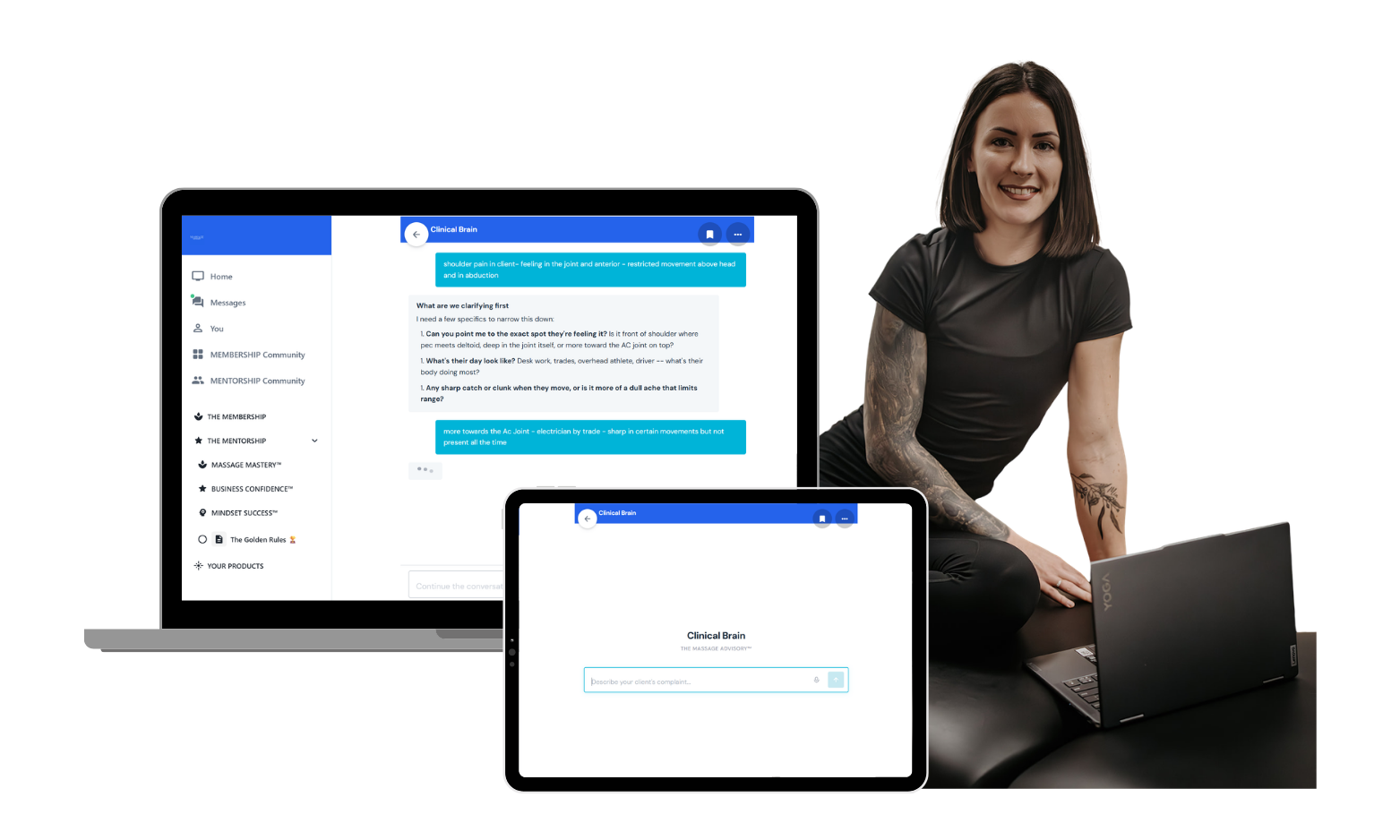
Describe the client. Get muscle-by-muscle priorities, a five-exercise home program, and the words to explain it — in about two minutes.
You've got the hands. The reasoning is the harder part
The client comes in with low-back pain, a stiff neck, a shoulder that keeps flaring — and none of it fits neatly into one pattern. You ask the right questions. You assess what you can. You use what you know.
Then the session ends and you're still not sure you prioritised the right areas, or what this client should actually be doing between now and next time.
You don't need another technique library. You need a better process for deciding what matters first.
Most therapists already have plenty of techniques. What's missing is a way to work out which areas deserve priority in this case, what order to treat in, how much to do, and how to explain the reasoning so the client actually follows it.
Meet the Clinical Brain
It's an AI-assisted clinical reasoning tool built for massage therapists. You describe the client and their presentation, and it helps you organise that information into a structured starting point for your own decision-making.
It isn't a diagnosis and it isn't a replacement for your assessment, training, scope of practice or judgement. It's a reasoning layer that helps you organise what's in front of you and decide what deserves attention first.
A truck driver with low-back pain
Worse after long shifts and prolonged sitting, better with movement, stiff getting out of the cab. Instead of reaching for your usual sequence, you put the case in and work through it.
Read the full case, step by step+
You still assess. You still decide. You still throw out anything that doesn't fit. The point isn't following an output — it's having a structured conversation with your own reasoning.
In the treatment room
- ✕The same sequence, most clients
- ✕Homework written from memory, under time pressure
- ✕"Stretch more, strengthen your core"
- ✕No clear way to review the case next time
- ✓A structured presentation to work through
- ✓Prioritised areas, tools and order
- ✓A specific five-exercise program with dosage
- ✓A saved case to open at the next appointment
It won't make every presentation straightforward. It gives you a practical way to think through the ones that aren't.
Built from real clinical frameworks, not theory

I'm Kat, from The Massage Advisory. I built the Clinical Brain out of the frameworks I use in my own clinic — the ones that came out of running a fully booked practice with a five-month waitlist, in real appointment times, with real clients who don't present like a textbook.
So it's designed around the actual constraints: limited time, overlapping complaints, work and lifestyle demands that keep feeding the problem, and the need to know when something sits outside your scope.
Straight out of my inbox
Unedited. Typos and all.
I use it mostly for the clients I get stuck on. Had a client with hip pain that kept coming back and I'd sort of run out of ideas, so I put the whole thing in the night before their next treatment and it gave me a plan plus some homework for her that I wouldn't have thought of. After using some of the suggestions during her treatment she had a really great response and for the first time in a long time has felt the pain level drop.
Honestly bought it because I was second guessing myself constantly and there's nobody to ask when you work on your own. I've been using it between clients, takes a couple of minutes. The red flag thing has made me feel a lot better about the ones I'm unsure whether to refer on.
As someone who works on my own, its been so useful to use. The treatment plans are so thorough and I love I can send my clients home with their own programs, its that little extra touch I think is really making my clients feel really cared for.
Having that depth of knowledge at my fingertips in real time is priceless. You've given me so much clarity, especially around assessments and setting expectations. As I transition into a more clinical space, I know these programs will be life changing.
Forty-seven dollars, once
- ✓AI-assisted clinical reasoning support
- ✓Red-flag screening prompts
- ✓Loading-profile interpretation
- ✓Muscle-by-muscle treatment priorities, tools and order
- ✓Five-exercise home programs with sets, reps and rationale
- ✓Plain-English client explanations
- ✓Automatically saved client cases
Add The Clinical Reasoning Series for $27 at checkout, if you want the thinking behind the tool.
Enter your details to continue
Fill this in and you'll go straight to the secure checkout.
$47 USD, once. If it isn't useful for the way you plan treatment, email support within the refund period stated in the refund policy.
What the Clinical Brain isn't
It isn't a diagnostic tool or a medical device, and it isn't a substitute for professional assessment, judgement, supervision or referral.
It won't make clinical decisions for you, and it isn't permission to work outside your scope. It gives AI-assisted reasoning support based on what you put in. How useful the output is depends on the information you enter, how you interpret it, and the decisions you make.
Before you buy
Is it a diagnostic tool? +
No. It organises information, gives screening prompts, identifies a loading profile and suggests treatment and exercise priorities. It doesn't diagnose conditions or confirm what's causing symptoms.
Do I still screen for red flags myself? +
Yes. The prompts support your screening — they don't rule red flags in or out. If a presentation concerns you, stop and refer to a suitably qualified health professional.
What information do I put in? +
Main complaint, symptom behaviour, relevant history, work and activity demands, aggravating and easing factors, your assessment findings, and how they've responded to treatment so far. Don't enter names, contact details or anything else that identifies the client.
Can I use the client explanations word for word? +
Use them as a starting point. Adapt them to the client, and don't present anything uncertain as a confirmed diagnosis.
Is there a subscription? +
No. It's $47 USD once, with lifetime access to the current product.
Is it any use if I'm still studying? +
It can help you learn to reason through a case, but it doesn't replace supervised education, assessment training or your educator's guidance. Use it within your course and supervision requirements.